02 Mar 2026
JRC study explores variety of innovation performances across EU regions
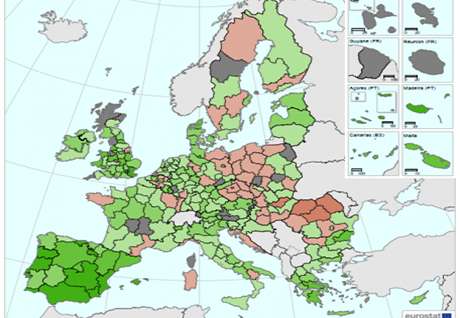
A new study by the European Commission's Joint Research Centre (JRC) was published on 27 February 2026. The study finds that EU urban regions lead in R&D investments, patents, trademarks and industrial designs, but some rural regions and confirms a persistent urban-rural gap, but also pinpoints rural areas which stand out with strong innovation capacity. This excellence is often connected to specialised industries, public research facilities or nearby urban innovation hubs, according to the JRC analysis. The results draw on newly developed granular metrics on R&D investment, patents, trademarks, and industrial designs.
In 2022, EU-27 regions spent roughly € 313.6 billion, corresponding to an average R&D intensity of around 2.2% of EU GDP, although with significant variations across EU countries. Urban regions invest approximately 2.4% of their GDP in R&D, accounting for more than half of the total R&D expenditure across the EU. This highlights the key role of large urban centres, such as Stuttgart, Brussels, Innsbruck, Stockholm, Toulouse, Berlin, Vienna, Helsinki, as research and technological development hubs. Rural regions on the other hand invest on average 1.6% of their GDP. Nevertheless, over 20% of rural regions perform above the overall EU R&D intensity average– remarkable examples are regions in Western Germany (Bautzen, Helmstedt), Upper Austria (Traunviertel, Innviertel) and south-western France (Lot, Tarn-et-Garonne), where R&D investment exceeds 3% of GDP.
Against an average of 380 applications per 100,000 inhabitants across the EU, patent activity is highly concentrated in around one-fifth of all EU regions. Leading innovation hubs are located mainly in Central and Northern Europe, especially in large metropolitan and specialised industrial regions such as Erlangen (Germany), Zuidoost-Noord-Brabant (Netherlands), Munich (Germany), Stockholm (Sweden), Helsinki (Finland) or Paris (France). The highest patenting rates are found in urban regions, averaging over 500 per 100,000 inhabitants, compared with some 180 in rural regions. Yet several rural regions outperform the EU average – for instance Hildburghausen (Germany) stands out as Europe’s top rural region with around 3,300 patent applications per 100,000 inhabitants. Some rural regions in Finland, Germany, Austria, and the Netherlands perform above the EU urban average. These cases often reflect strong industrial specialisation and close links with nearby urban innovation hubs, showing the innovation potential of rural areas under the right circumstances.
The study furthermore looks at the regional distribution of trademark activity and industrial design activity. With regard to innovation capacity, the study again finds that this remains unevenly distributed across European regions. The positive performances of several rural and intermediate regions point to the importance of urban-rural links, public-private cooperation, and tailored measures helping rural territories harness their potential.
For more information: