20 Apr 2026
ERAC holds its first meeting in 2026 in Nicosia (Cyprus)
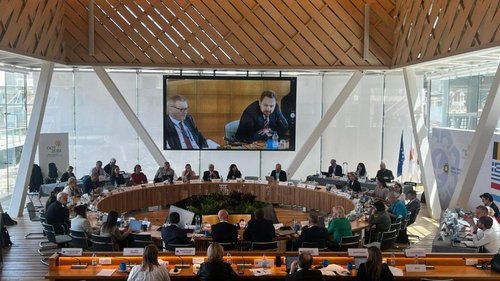
The Directors-General responsible for research and innovation in the EU Member States and Associated Countries and the European Commission met for the first ERAC Plenary since last October. The meeting took place on 15 and 16 April at the town hall of Nicosia, upon invitation of the Cyprus presidency of the Council. The main focus of the meeting was the priority setting for research and innovation and the approach to European Partnerships in the context of the future Framework Programme (FP10 /HEU 2028-2034) and the new European Competitiveness Fund (ECF).
The meeting started with the adoption of the new ERAC Work Programme for 2026-2027. The committee decided to start a discussion process on the future role of ERAC for the period of 2028 and beyond, taking into account new developments and challenges in the context of the new MFF programme generation, as well as the upcoming Innovation Act and ERA Act.
The discussion on guiding principles for priority setting for research and innovation had two main aspects. One was the priority setting in the context of the FP10-ECF nexus. Starting from the assessment that the “strategic programming” practiced in the current Horizon Europe programme (2021-2027) has not been working quite as well as it should have, a new, more effective and more feasible approach is envisaged. The discussion on this aspect showed strong convergence of views among the delegations. In the end, it was decided to aim at establishing a priority-setting process that is based on a strategic policy orientations document which is evidence based, informed by foresight, expert opinions and national stakeholder consultations. This document should then be the basis for establishing the Work Programmes within the comitology framework of the ECF-Horizon Europe nexus. This priority-setting process would be performed twice per MFF period (one 3 and one 4 year period). Details of this process as well as the role of ERAC in it still have to be discussed.
The second aspect of the priority setting discussion was the potential further impact of priority-setting in the FP10/ECF context on the alignment of regional, national and European R&I funding along identified strategic priorities in order to create critical mass. The need for such alignment was underlined by many delegations in the discussion. The preference is clearly for a limited number of initiatives the would cut across the full range of TRLs from research to deployment. Again ERAC might play a role in the implementation of such an approach that could be pursued with existing as well as new instruments, and that could potentially be based on a refurbished ERA governance laid down by the ERA Act. Article 184 TFEU was mentioned as one example for a new instrument .
The second strategic discussion focussed on the approach to European Partnerships under Horizon Europe 2028-2034. This approach is naturally related to the discussion on priority-setting, given that European Partnerships are both an important instrument for the implementation of the Framework Programme as well as for the alignment of regional, national and European R&I funding and policy. Again there was strong coherence in the main orientation of the ERAC delegations' interventions. Partnerships are seen as a potentially powerful instrument. Most delegations expressed their preference for a limited number of Partnerships, without setting a numerical limit, by strictly applying selection criteria that include strategic relevance and strong European added value. The existing R&I landscape should be taken into account to ensure complementarity and avoid duplication. Partnerships should be strategic and integrative and have effective governance structures and implementation arrangements. Combining research and deployment should be the rule, but Partnerships in the field of social sciences and humanities should also be possible. Regarding already existing Partnerships, the view prevailed that they need to be strictly scrutinised against the selection criteria before considering their continuation. Many delegations called for simplification both in terms of the portfolio and of the structure and implementation modalities.
Finally, ERAC discussed the issue of science diplomacy. While a proposal for Council Recommendations for an EU Framework on science diplomacy is currently negotiated in Council, ERAC, inspired by a presented case study done by Professor Papanicolas from the Cyprus Institute, shared the view that science-based cooperation can foster trust and address transboundary challenges such as climate change, and that it has strong potential in general to contribute to political and societal progress.