18 Nov 2025
Austrian ERA Symposium 2025 discusses path towards the Fifth Freedom
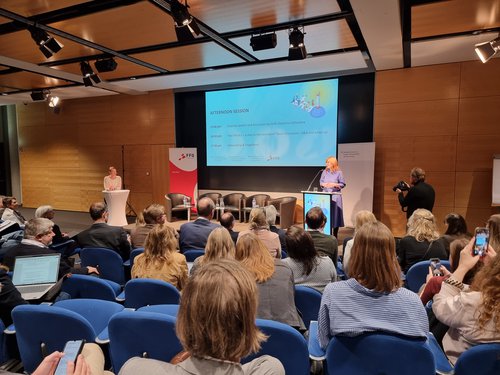
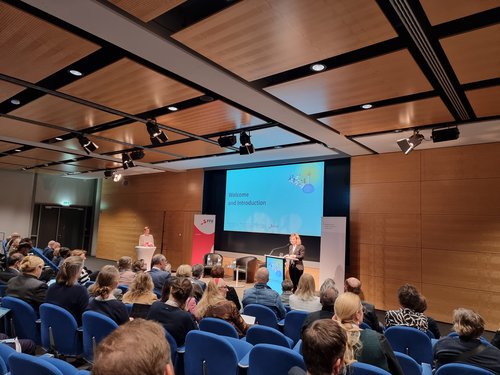
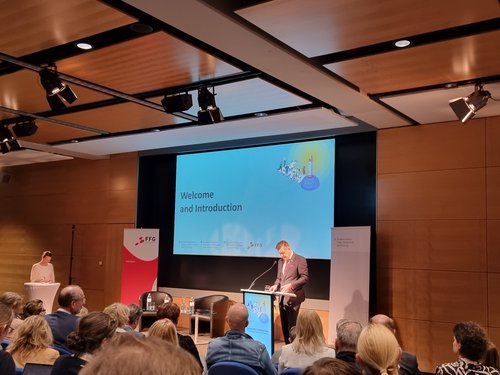
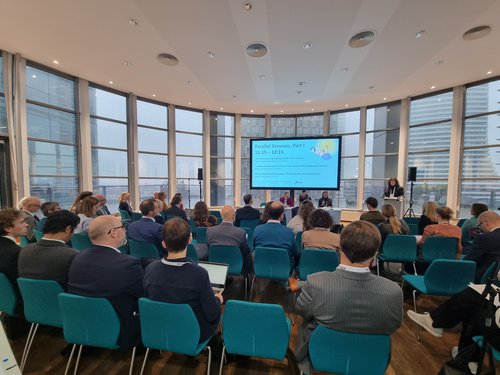
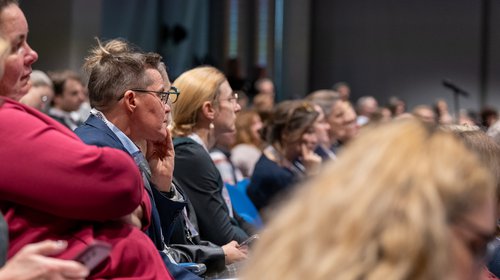
On 17 November 2025, the third Austrian ERA Symposium took place in Vienna. About 200 participants from across the Austrian RTI system, including representatives of ministries, higher education institutions, research agencies, research performing organisations and the business sector, as well as guests from the European Commission and other European countries came together in the “TechGate” in Vienna’s 22nd district to discuss the future of the ERA at European and national level.
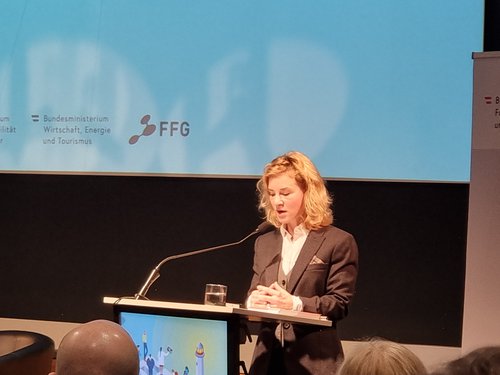
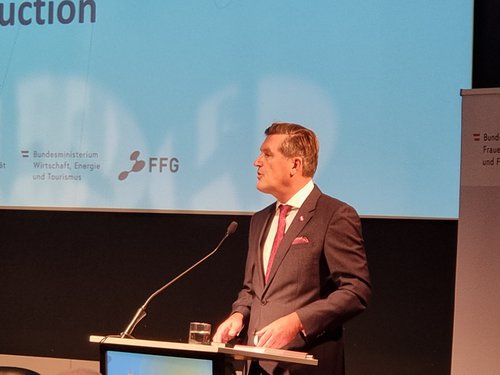
The event was opened by Minister for Women, Science and Research Eva-Maria Holzleitner and Minister for Innovation, Mobility and Infrastructure Peter Hanke with their opening speeches. EU Commissioner for Start-ups, Research and Innovation Ekaterina Zaharieva gave a keynote speech in the afternoon. These prominent contributions were complemented by a colourful programme which included the presentation of the new Austrian ERA Action Plan 2026-2028, parallel workshops featuring six selected ERA Action Plan initiatives, and a panel discussion on the upcoming ERA Act.
In her opening speech, Minister Holzleitner outlined the great importance of EU Member States standing and acting together in these times of multiple crises and challenges. The minister highlighted the achievements of the ERA over the last 25 years and highlighted the relevance of the new ERA Policy Agenda 2025-2027. Ms Holzleitner argued that under the current circumstances, Europe cannot continue with business as usual but must become more determined and ambitious in its efforts to overcome fragmentation and build critical mass in strategic areas. In this context, the Minister referred to the ERA Act that could and should be a crucial step towards the next level. Minister Holzleitner also emphasised Europe´s role in promoting long-term democratic values, mentioning peace in particular, and expressed her hope for Europe to become hub for peace, conflict and preparedness research.
Minister Hanke emphasised in his welcome address the importance to strengthen national networks and anchor them in a European framework, especially in times of global uncertainty. He highlighted Austria's long-standing involvement in European Partnerships and Missions under Horizon Europe, its active participation in technology platforms and governance structures, and its engagement in Important Projects of Common European Interest (IPCEIs), stating that all of this reflects a policy that sees cross-border cooperation not as an exception, but as the rule. Minister Hanke furthermore referred to the ERA Act that should provide new tools for advancing the European Research Area. In this respect he stressed that Member States must be strategically involved – in governance, in setting priorities, and in shaping implementation.
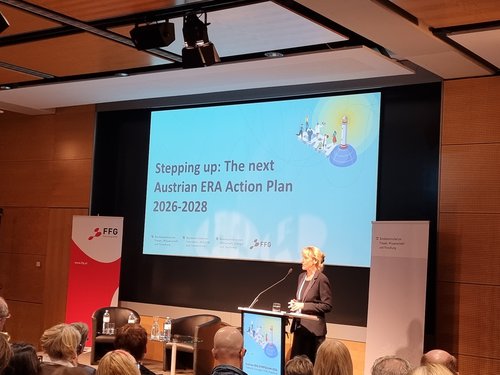
Director-General Barbara Weitgruber from the Federal Ministry of Women, Science and Research then presented the structure and content of the second Austrian ERA Action Plan (ERA-NAP) 2026-2028 (slide presentation see below). The next ERA NAP will carry the subtitle 'For the Freedom of Science and Research; Excellence and Progress in a unified and democratic Europe'. Barbara Weitgruber explained that the next national ERA Action Plan has been finalised, involving several ministries and stakeholders from across the Austrian RTI system, and that it is expected to be published by the end of this year after it has been endorsed by the Austrian Council of Ministers. The Director-General explained the structure of the Action Plan with its five fields of action and 15 initiatives along most of the policies and actions of the ERA Policy Agenda 2025-2027, while focussing on the specific needs of the Austrian RTI system and institutions.
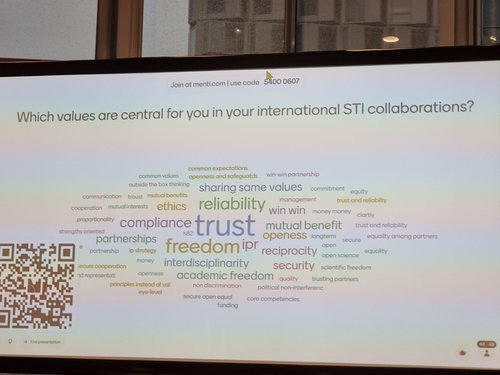
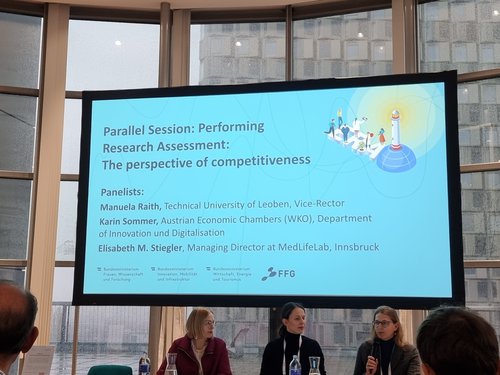
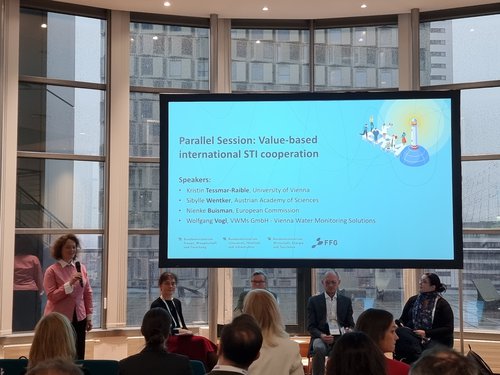
The symposium continued with two sets of three workshops in parallel. Each of the six workshops featured one of the 15 initiatives of the national ERA Action Plan 2026-2028, focussing on concrete steps of their implementation. The workshops addressed the following aspects: Accelerating and facilitating the use of AI in Science; Towards an integrated structure for the research ethics landscape in Austria; Reforming Research Assessment: The perspective of competitiveness; From Policy to Practice: Advancing Equity in Open Science; Strenghtening Trust in Science: Ways to enhance public participation; and Value-based international STI cooperation. The workshop organisers represented the leading teams of the respective ERA-NAP initiatives. Valuable input for the upcoming implementation of their respective initiatives was provided by the active contributions by the workshop participants.
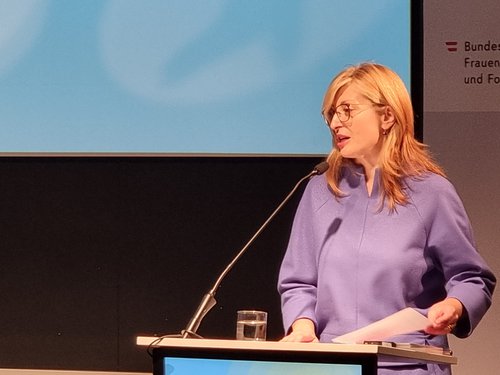
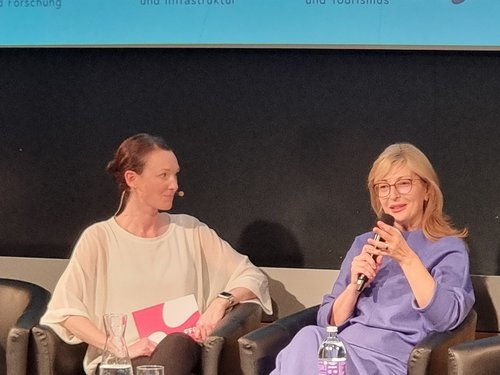
After lunch, Commissioner Zaharieva gave her keynote speech. Like Minister Holzleitner and Minister Hanke, the Commissioner emphasised the importance of ERA, and of joint action in research and innovation in the EU, stating that "We must make the fifth freedom a reality for all". She stressed that the ERA Act is the first legal instrument of its kind, "designed to improve the lives of the research community", and a new legal approach to boost efforts to reach the 3% target. According to the Commissioner, a further motivation for preparing the ERA Act is that Europe needs to remain a global magnet for international talent. In this context, Ms Zaharieva referred to the fact that scientific freedom is under pressure in many areas of the world, and that many of the best global minds are already choosing Europe, under a total of 75 national and regional initiatives for "Choose Europe. The Commissioner invited the audience to contribute to shaping the ERA Act by participating in the ongoing public consultation on the ERA Act that will remain open until 23 January 2026. The Commissioner mentioned the “European Innovation Act”, as complementing the ERA Act by accelerating the translation of research into marketable solutions, that is also on the Commission's Agenda and is also currently in preparation.
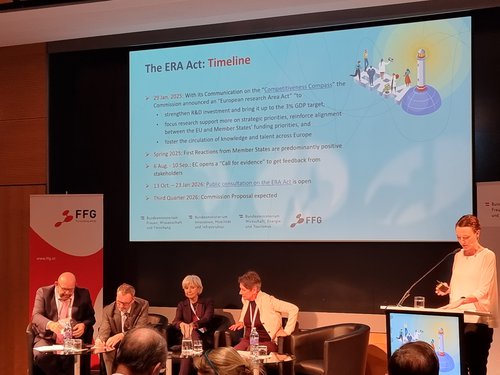
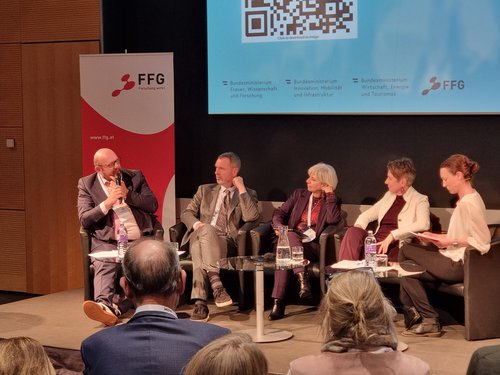
The final item on the agenda was a high-level panel discussion on 'The ERA Act – a step to next level?', with Jean-David Malo, Acting Director for ERA & Innovation in the European Commission, Alexander Grablowitz from the German Federal Ministry for Research Technology and Space, Manuela Baccarini, Vice-rector for Research from the University of Vienna, and Sabine Herlitschka, CEO of Infineon Technologies Austria as the panellists. They joined moderator Maggie Childs for a highly interesting as well as entertaining discussion. Jean David Malo repeated the clear commitment of the Commission to propose an act that entails substantial legislation with the potential make a considerable step towards the fifth freedom. Among the areas that will most likely feature in the ERA Act he mentioned inter alia research careers and mobility, and research infrastructures. In connection with the latter, Mr. Malo mentioned that the ESFRI framework needs to take the next step regarding access to research data. In his view, this step is crucial in view of the current situation where data from publicly funded research is simply not available. He could, however, not provide details of the content of the ERA Act, as work is ongoing and the public consultation is still open. In reply to a question from the auditorium, Jean-David Malo confirmed that the ERA Act will include “something” on the freedom of scientific research. He also emphasised that “fundamental values” will play an important role in the ERA Act.
Alexander Grablowitz ensured the Commission of Germany's support for a brave proposal for the ERA Act. He mentioned three crucial criteria for successful elements of the ERA Act, which are: “Will it become relevant? Will it make our life easier? and will it contribute to competitiveness?". From their respective perspectives – the academic sector and industry - Manuela Baccarini and Sabine Herlitschka then made a strong plea for ending decades of tiny steps, to now “finally get it done”, as the CEO of Infineon Austria put it. Ms Herlitschka also said that this could be the “golden age” of European integration in research and innovation if we can achieve a real single market. Regarding the ERA values, which Jean-David Malo had mentioned as important, Sabine Herlitschka said that they would need to be "competitiveness-proof". For Vice-Rector Baccarini, the primary focus naturally is on the researchers and the academic institutions and the restrictions they still face in transnational mobility and collaboration. Five years of experience with alliances in the European Universities Initiative had convinced her that it would not be possible to continue like this, but that “borderlessness” was needed for science and research in Europe. Both the panellists' statements and the contributions from the audience showed strong support for an ambitious ERA Act.